Have you ever seen two shifts run the exact same job – same press, same SKU, same settings on paper – and yet one costs significantly more to produce than the other?
Sure, wages are one way to explain it – but what about when the team is all paid the same?
In my experience, the real cost difference doesn’t come from salary, but rather from the small, invisible leaks that happen all the way through production.
Walk into a press room mid-morning and you can usually tell which shift is in control. One operator is halfway through a run, moving at a steady rhythm, loading and unloading without hesitation. Across the room, another press is still chasing its first clean print. The platen’s been adjusted twice, pretreatment reapplied once, and the first five garments are already in a growing spoilage pile. And, of course, nobody’s written anything down…
When jobs are short and changeovers are constant, setup is where most of the damage is done. A setting off by a few millimetres. A cure that runs a few seconds shy. Pretreatment sprayed just a touch too light. None of these feel like disasters in the moment, but they add up fast. In high-throughput shops, there’s no breathing room to fix them before the next job is queued. Even the best operators slip under that kind of pressure (often unknowingly) and when they do, the costs roll quietly into the background: wasted garments, extra press time, missed delivery windows.
Over weeks and months, these habits split shifts into two camps: the crews who set up cleanly and run without fuss, and the ones constantly firefighting or chasing their tails. The first group delivers repeatable quality with minimal rework. The second racks up unplanned downtime, untracked waste, and jobs that have to be rescued by the “go-to” operator everyone relies on to fix things (I’m sure you know who I’m talking about). On paper, both shifts cost the same. In reality, one is burning a hole in the margin.
How disciplined shops lock it down
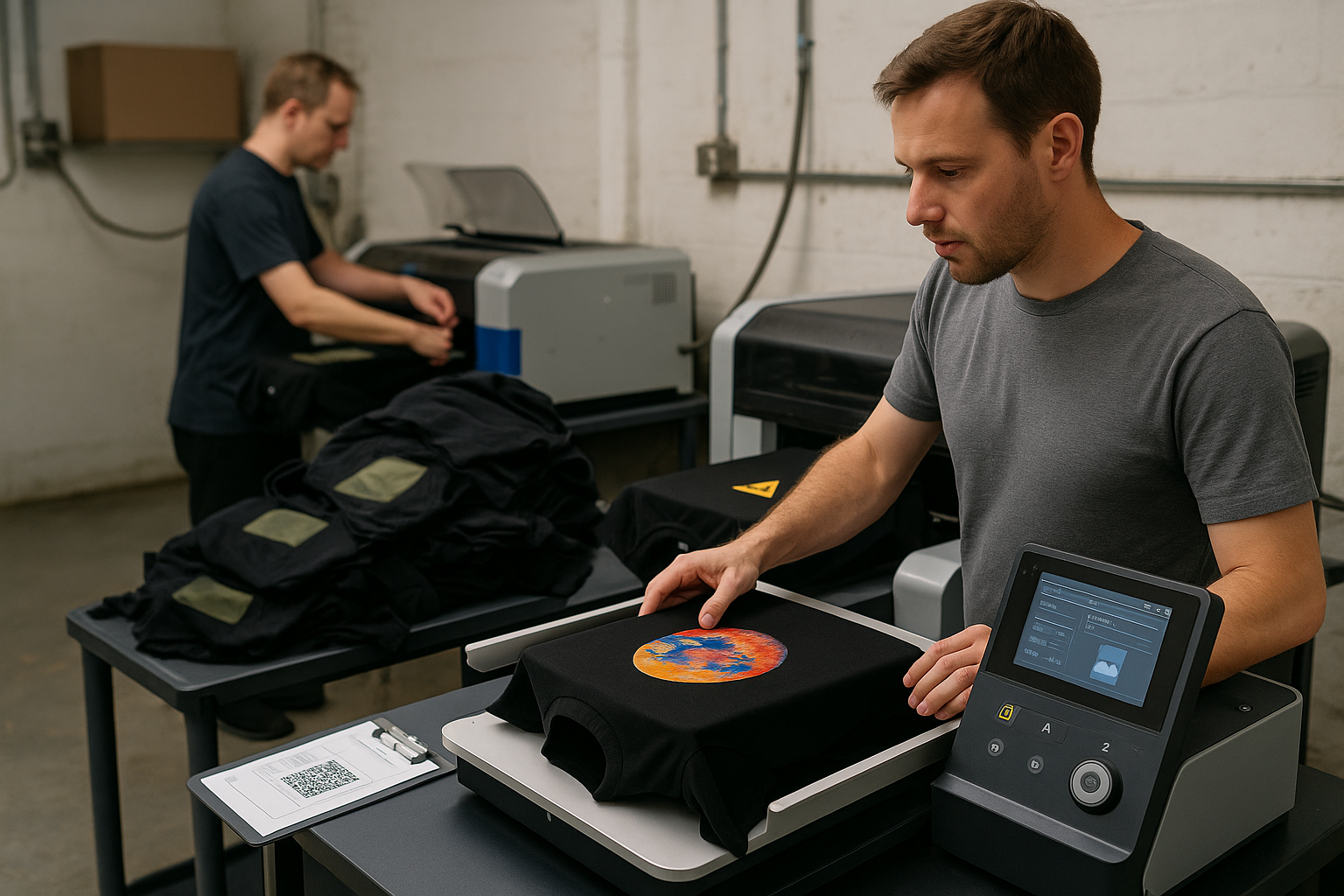
Operators and managers that I speak to don’t just keep their costs down by being “better” at printing – they’ve stripped the guesswork out of setup. Parameters for each garment type and SKU are documented and easy to pull up. The best I’ve seen have QR codes printed on the job sheet that, when scanned, display the correct platen, ink mix, placement, press temperature, and cure time on-screen at the station.
Alignment is no longer a matter of “that looks about right.” Simple, permanent visual references make it obvious where a garment sits. There’s no need for trial-and-error when the markers are right there. Spoilage isn’t swept aside or tossed in a bin – it’s logged immediately with a reason. Over time, those entries form a map of where setup is failing: which products are prone to misalignment, which operators are fighting the same issues, which presses drift on temperature.
And better yet, the best of the facilities I deal with actually act on that data. Training isn’t built around vague examples at those firms, it’s built around the real mistakes that happened on that floor, in that shop, last week. Operators can see the link between what’s measured and how the work improves, and they know the purpose is to make the next run better, not to single anyone out.
In shops like this, all you see is consistency across shifts. Repeat jobs look the same no matter who runs them. Presses aren’t stopping mid-run to adjust settings. The most experienced operators are focused on production, not cleaning up after everyone else. And the cost per shift stays predictable.
Take Stock: Is Your Press Line Under Control?
These are five of the most important factors in keeping shift costs steady and the press line profitable. Tick the ones that apply to you:
- Are setup steps for repeat jobs documented, easy to access, and followed the same way by every operator?
- Can you retrieve press and cure settings for any job instantly, without relying on memory or scraps of paper?
- Is spoilage tracked in real time, with a cause logged for every single reprint?
- Do repeat jobs produce consistent quality across all shifts, regardless of who’s on the press?
- Could a less experienced operator run a complex job tomorrow and get it right without needing a senior operator to fix it afterwards?
If you ticked all five, your press line is already in strong shape. If not, we’ve got a longer checklist based on the most consistent, lowest-waste operations we’ve worked with. DM Andrew and we’ll send it across.