Productivity sounds simple: how much output you get from a process over a given period of time. But in practice, measuring it properly – and using that measurement to actually improve a business – is far more complicated.
Most people imagine productivity like a conveyor belt. Five items come in, five items go out in an hour, so you’ve achieved 100% productivity. Simple enough. Others imagine a situation where there’s an infinite pile of work to do, and productivity is measured purely by how many units you complete: 700 in an hour, 500 the next, and so on. Both ways of thinking are valid, depending on the context. But they barely scratch the surface as a holistic measure.
Real productivity management needs to account for multiple competing ceilings. And unless you can clearly define where your ceiling is, you’re guessing. Not measuring.
3 Production constraints
Every production process is ultimately constrained by one of three things: demand, supply, or operator performance.
Demand is simple. There’s only so much work available to do. If a station can easily handle 200 units an hour but only receives 100 units to process, it doesn’t matter how fast the equipment or the operator is (as long as it’s more than 100 units per hour). You’ll cap out at 100 units simply because that’s all there is to do.
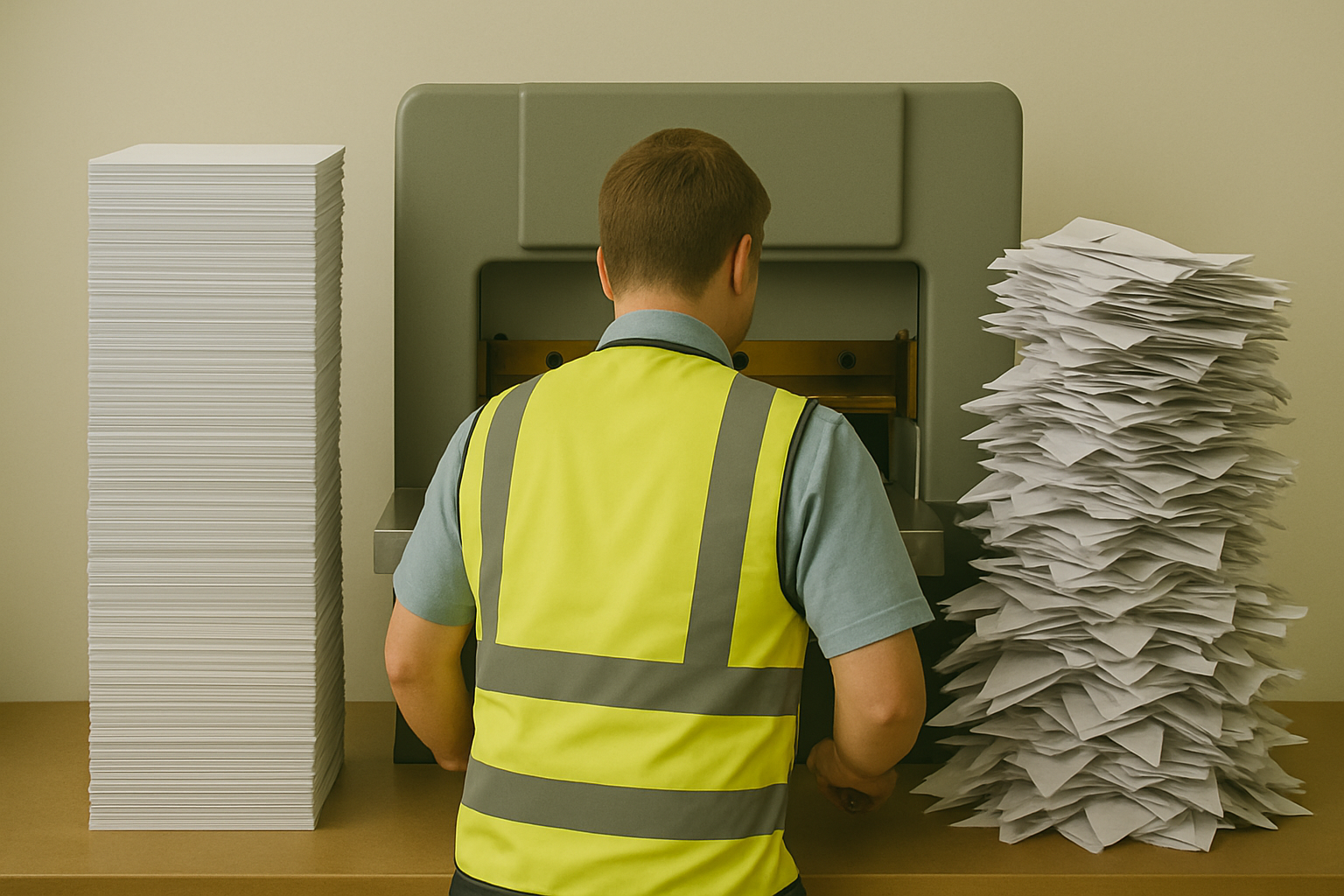
Supply is about machine and tool capacity. Even if demand is unlimited, machines impose a hard limit. A guillotine might only be capable of cutting 1,000 units an hour, no matter how skilled the operator is. In that case, the machine’s rated capacity is the ceiling.
Operator performance is the third limit. If demand is high and the machines are capable, but the operator can’t hit the expected throughput, the limitation is the human. This is the hardest ceiling to fix, but also the most important to recognize early.
When productivity is low, the natural instinct is to blame the operator. Sometimes that’s justified, but often it’s not. If demand is the constraint, you can’t fault an operator for having nothing to work on. If the machine is the constraint, you can’t expect a human to perform miracles beyond the rated equipment capacity. Understanding which of these three ceilings is at play is the only way to respond properly.
If demand is the issue, you need to increase volume, or adjust how you measure productivity – maybe switching to smaller bursts, like 15-minute output windows instead of full hours. If the machine is the issue, you need to upgrade equipment, adjust workflows, or add additional stations. If the operator is the issue, you need to retrain, support, reassign, or eventually replace. It’s uncomfortable, but it’s the only honest approach.
Good businesses aim to have machine capacity be the bottleneck. Machines can be upgraded and supplemented with money. Fixing productivity issues tied to demand or people is much harder, and much riskier.
A path forward
But none of this matters if you don’t have data. You need to know how much work was available at a given station, what the machine’s expected capacity was, and what the operator actually completed. Without clear tracking on all three, you’re guessing. You’ll either punish the wrong people, waste capital on the wrong upgrades, or make operational changes that don’t move the needle.
ZenSmart makes it simple to track demand, supply, and actual throughput hour by hour. Not theoretical numbers. Real production performance. And that visibility is critical, whether you’re managing human operators today, or robots tomorrow. The principles don’t change.
Capacity doesn’t equal flow. Having the ability to produce doesn’t mean you’re producing efficiently. True productivity is measured not just by raw output but by how closely you are operating to your real ceiling – whatever that ceiling happens to be.
You can be great in one area and terrible in another. Unless you’re tracking all three areas in parallel, you won’t know where the real bottleneck is. And if you don’t know where the bottleneck is, you can’t fix it.
Measure properly. Understand your ceilings. Build better workflows around them. That’s how real productivity gains happen.