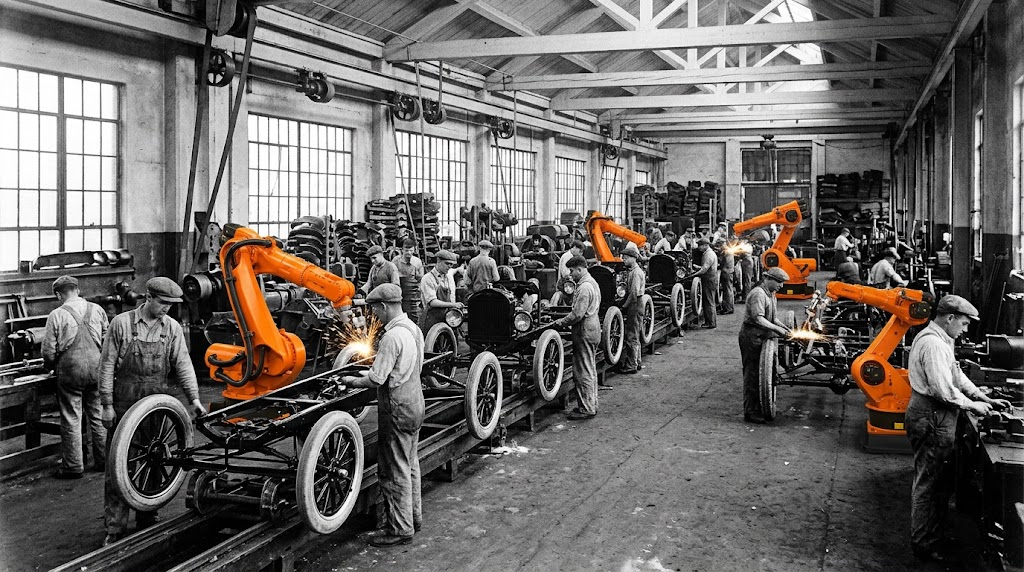
In 1913 Henry Ford’s Ford motor company was making a chassis every 12.5 hours. By 1914 the moving assembly line innovation had turned that into 1.5 hours and coach building had become mass manufacture.
The next 10 years was a period of explosive innovation across a range of inputs to how cars were made. Individual electric motors (they were previously factory wide machines), the 8 hour shift, powered lift trucks and connected supply chains drove even higher productivity. The moving assembly line was the headline but the intersection of parts, labor, coordination of resources and standardization reinforced the innovation.
So, what’s that got to do with make to order (MTO) and print on demand (POD)?
The key question: is this 1913 for our industry? Is the intersection of automation software, machine automation and AI creating the ingredients for a very new approach to how unique manufacturing work can be scaled?
Some are more sceptical about the broader implications of AI. Torsten Slok, chief economist at Apollo Global Management was widely quoted this week saying artificial intelligence has delivered “zero financial payoff to corporate America outside of tech.” All the value has accrued to the Magnificent 7, while the needle has not shifted for the other 493 companies in the S&P – measured by revenue per worker and profit margins.
But make-to-order is a special case. AI pays off where the problem is complexity, and that’s the one problem long-run manufacturing never had.
The reason is that in long run manufacturing, scaled repetition has been the driver of success. Henry Ford enabled execution of a single consistent task (provided it was black) at scale. But, for make to order the issue is that product ranges are so large and production so fragmented – that long run manufacturing techniques don’t work. As an industry our productivity mountain has still to be climbed.
The industry is still building coaches – tens of thousands of product/flow/option combinations means that work is mostly still manually organized. And even worse understanding the product portfolio in terms of what product + materials+ manufacturing flow + labor+ option + contract combinations are making the ‘real’ money is beyond almost every business.
In make-to-order – AI + automation + smart machinery enables execution of product-manufacturing combinations in an intelligent and systemic way – our equivalent of the Henry Ford assembly line. It enables the optimization of the factory to flexible goals that can change from week to week, day to day or even hour. Think optimization for profit, SLA compliance, quality or protection of your best customer – all in a click, driving production sequencing and resource allocation, to a known profit.
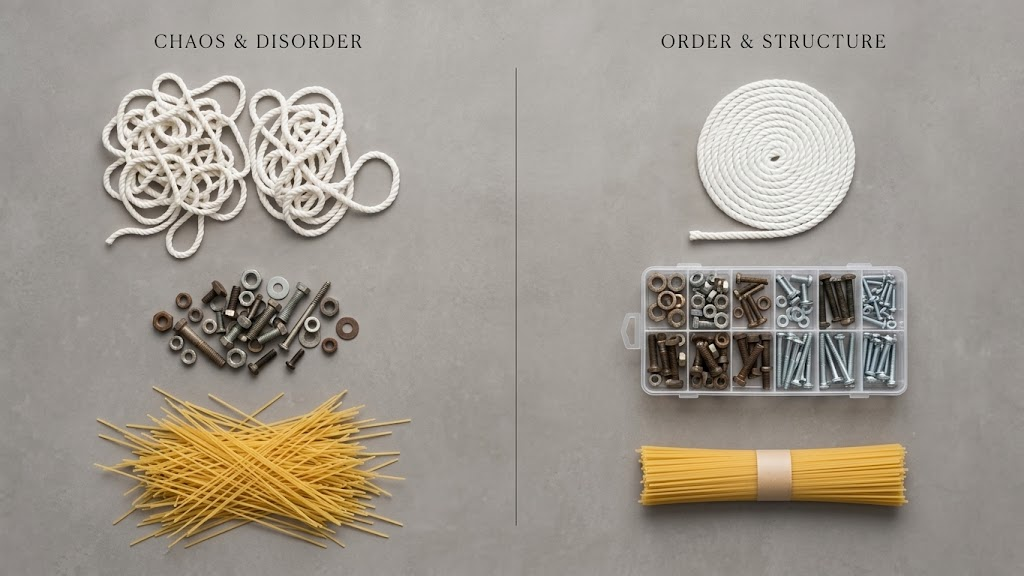
The outcome is repetition of mass complexity. Ford never solved complexity – he eliminated it. The innumerable manufacturing combinations of a merch, apparel, photo, signage or digital plant can be executed in one orchestrated solution.
So, if you have scan-to-make and full action tracking in place (our lift trucks and electric motors) the world of Print on Demand and Make to Order looks a very different place as we head into 2027.
It’s time we stopped building coaches and started running a production line.