WhatTheyThink published its Quarterly Edition 1, 2026 last week – themed around ‘Keeping Up Appearances’, with embellishments as the centrepiece.
It’s good timing. In my conversations with print businesses across the US, Australia, and UK, embellishments have become one of the most actively pursued areas of product line innovation in the industry right now.
It makes sense. Spot UV, soft touch lamination, embossing, metallic inks, foiling, raised coatings – these techniques are tactile and visually arresting and in our very busy world, attention drawing. When consumers are drowning in visual stimulation, embellishment is one lever that drives cut-through. It creates a point of difference. Margins are better. And the technology to deliver it has never been more accessible.
The direction of travel is clear. The harder question is what it does to your production workflow – and whether your operation is set up to absorb the complexity and fragmentation that comes with it.
The Complexity Trap
The reality I see play out repeatedly is that a business adds say, spot UV. It works well, margins are good, customers love it. Then soft touch lamination. Then foiling. Each addition makes commercial sense in isolation. But collectively they fragment production.
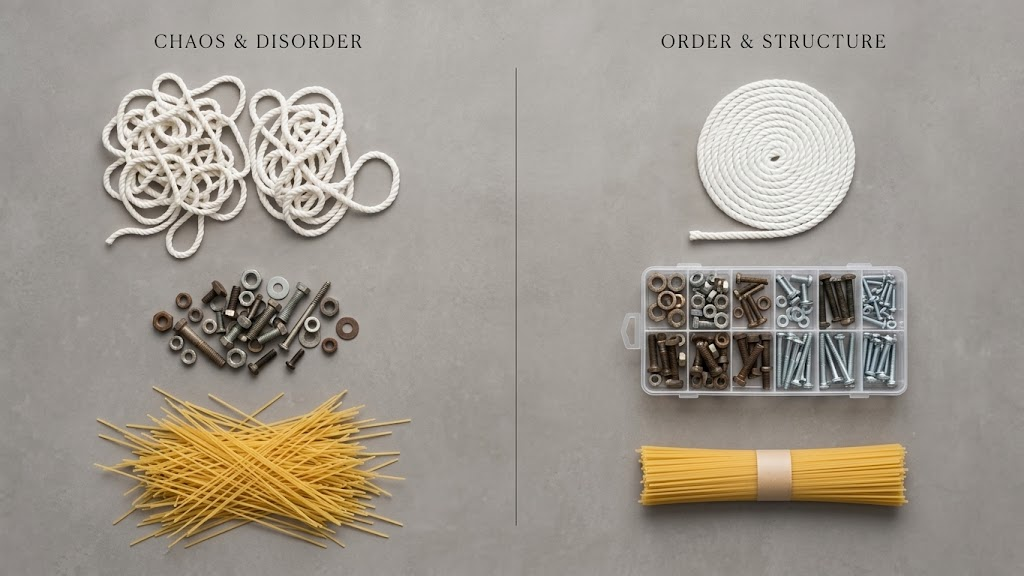
Every embellishment type creates its own workflow path – its own press stage, finishing step, drying or curing requirement, plus a quality check. As the menu of options grows, queue and batch logic becomes more complex (it’s actually exponential). And this problem is compounded by a trend that’s been running for years: average job sizes are shrinking.
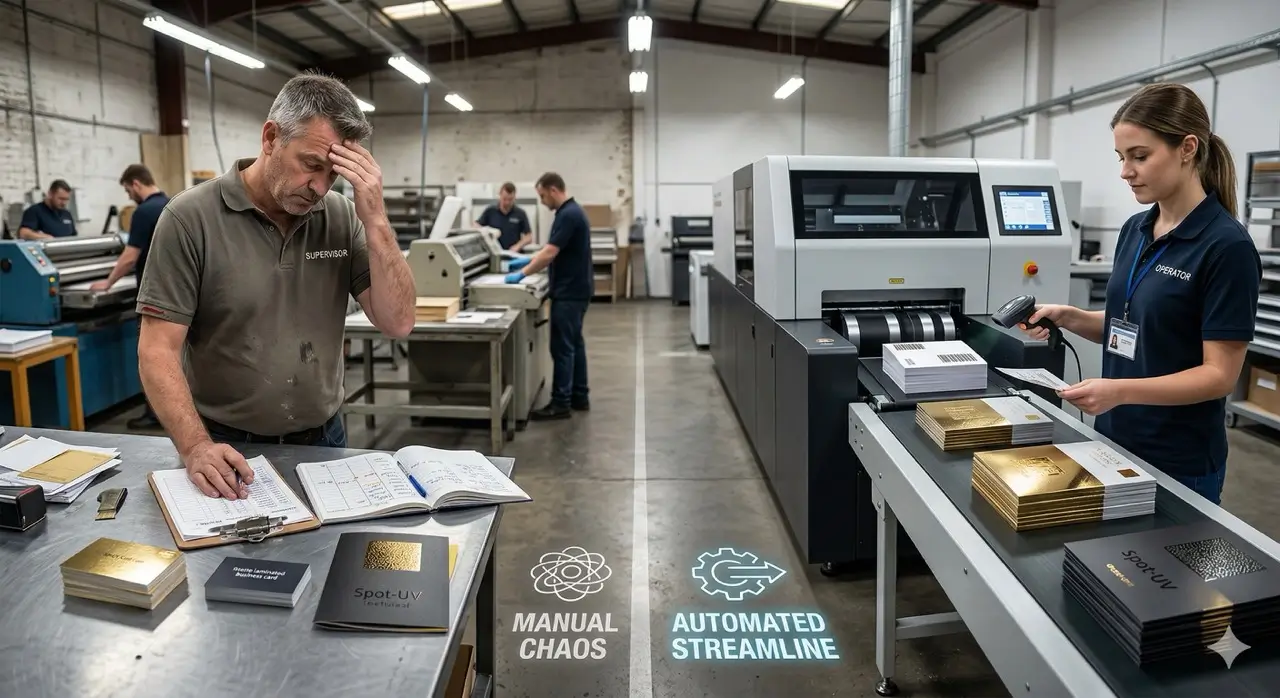
The combination of more embellishment types and smaller average jobs means batches get smaller, costs per unit go up, and scheduling becomes a manual puzzle that someone has to solve fresh every day. Unfortunately, often a single person who knows-it-all.
Add three or four embellishment techniques to a busy site and you don’t just add process steps – you add coordination overhead (and opportunity for error) that quietly eats into the margins you were trying to protect.
Automation Turns Complexity Into Simplicity
The good news is that workflow automation is specifically designed to absorb this kind of complexity – and convert it into something the factory floor can execute cleanly and profitably.
The mechanism is straightforward. Rather than scheduling embellishment work manually, an automation platform continuously scans the order queue, identifying all work that shares a can-make-together production path. It applies your business-logic closes batches to optimal size based on least cost and target due date – not when a scheduler gets to it, but continuously and in real time. When a batch is ready, it’s released with its full workflow definition – imposed, ganged, barcoded and stages of production defined all with no pre-press intervention.
For the team-member on the floor, all that complexity collapses into a barcode scan. They don’t need to know whether a job has spot UV or soft touch or foiling – the system knows, and the barcode drives what happens next. The knowledge load stays with the automation solution, not with your people.
The practical outcome is that you can run a full portfolio of embellishment techniques at genuine scale. Which means not just technically possible, but profitably – because the platform’s batching logic is working constantly to keep unit costs under control – even as job sizes shrink and your product variety grows.
A quick health check
- How many embellishment techniques are you currently offering – and how many are you manually scheduling?
- As average job sizes shrink, are your batch sizes holding up – or is makeready cost per unit creeping higher?
- Does your floor team have to interpret workflow paths, or does a scan tell them exactly what to do next?
- Could you add another embellishment type tomorrow without adding a coordinator to manage it?
- Is the complexity of your current embellishment range a reason you haven’t extended it further?
Embellishments are worth pursuing. The WhatTheyThink piece is right – this is where a meaningful slice of print growth is happening. The question is whether your production infrastructure grows with it, or becomes the ceiling that limits how far you can take it.
If you’d like to talk through how workflow automation handles embellishment complexity in practice, reach out – it would be great to work through the logic.