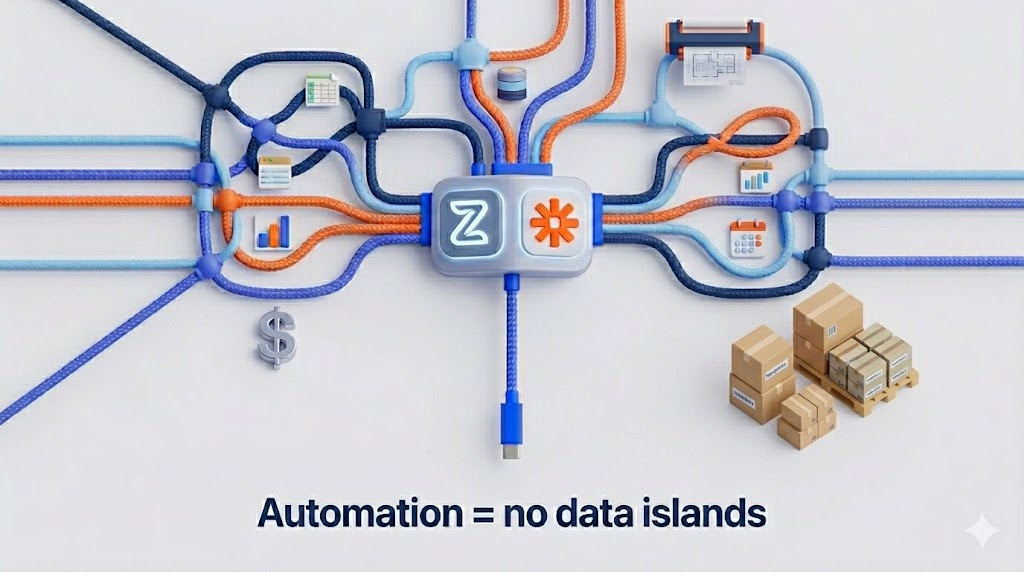
I had a conversation a few weeks ago with an apparel deco business running a reasonably well known industry Apparel ERP solution. A good platform but it’s an island and has no API – sigh. Every morning, someone was manually creating orders and moving files around – which is why we were talking to them.
That conversation is more common than it should be in 2026, and it points to something fundamental about automation: the outcome of automation will be maximized where all your information islands are bridged.
Integration is the foundation stone.
Strong production automation is based on deep, reliable connectivity with every system in your factory ecosystem — order sources + marketplaces + e-commerce platforms, ordering, inventory, production equipment, ERP and logistics providers. Getting rid of the black holes.
So far we have built a library of more than 100 direct connections into the ZenSmart platform — from Shopify, Amazon, and Etsy on the order side, to Kornit, Fiery, Caldera on the production floor, to FedEx, Starshipit, and others for fulfillment. Printavo, DecoNetwork, OrderDesk, WooCommerce, BigCommerce, Pressero – the list is long and still not enough. No integration library, however extensive, covers every platform in use across every market. So, enter Zapier…..
What is Zapier? And why is it still relevant in an AI-driven world
Zapier launched in 2011 with a simple premise: let any business connect two software platforms together without needing a developer to build the bridge. At the time, it was novel — a no-code automation layer that meant a small business could wire up their CRM to their email platform in an afternoon rather than spending decent money on a custom integration project. Fifteen years later, over 2 million businesses use it to connect around 9,000 applications.
The interesting question now is whether it still earns its place in an era where AI-powered integration tools are increasingly available?
I think the answer is still yes. Zapier’s value has always been in its breadth of coverage and its low barrier to entry. Neither of those things has been displaced by AI. What AI tools tend to do well is help you configure and troubleshoot integrations faster – but you still need the underlying connectors to exist, and the Zapier community has spent fifteen years building that library.
For operators who want to connect a business system to ZenSmart (which could even be as simple as an Excel Spreadsheet or obscure ERP), Zapier remains one of the most practical paths available.
Announcing ZenSmart native Zapier integration
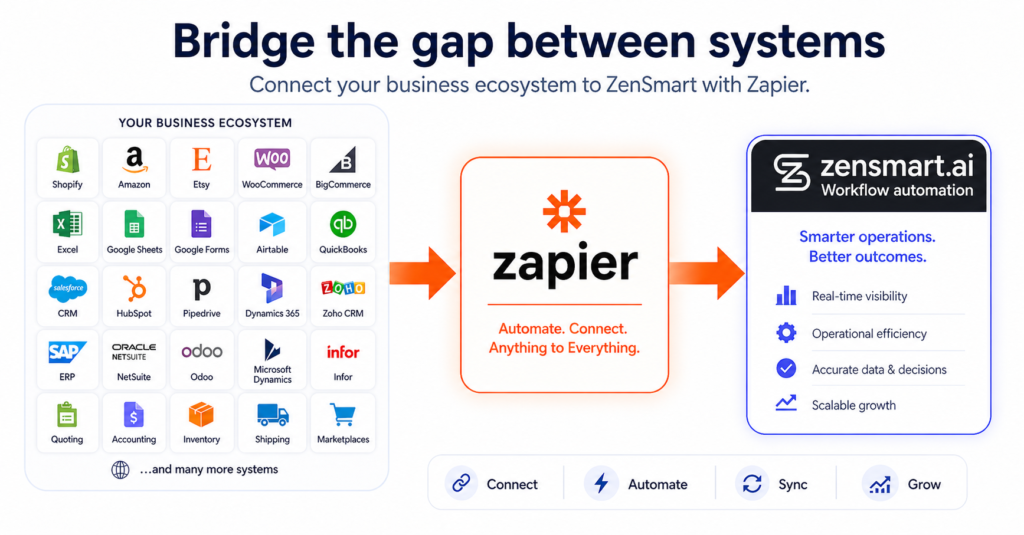
Today we’re announcing the launch of native Zapier integration for ZenSmart. This means any of Zapier’s 9,000-plus connected platforms can now feed data directly into a ZenSmart production workflow. This means, from any of those 9,000 systems, the ability to automatically create new Orders within the ZenSmart platform, cancel Orders or mark them as complete. Customers receive a share link, connect their ZenSmart tenant credentials, map their source trigger fields to the ZenSmart action and are live within minutes – there’s no custom development required on either side.
When does this matter most?
The most immediate use case is for:
- Platforms outside our existing direct integration library – particularly the quoting, shop management, and inventory tools common in decorated apparel and merchandise markets. If you’re running ShopWorks, ShopVox, ApparelMagic, Zoho, or TradeGecko, a Zapier connection gives you a fast, low-code path into ZenSmart production without waiting for a custom build to be commissioned and delivered.
- Building multi-step automations — for example, you might have a CRM system with some customer ranking data that might apply a custom production priority flag. You can use Zapier to connect that system and take your automated production workflow to the next level with ZenSmart handling the automation of that workflow. You can even connect in Claude or ChatGPT for analysis and interpretation.
- Legacy – siloed systems – you can use Zapier to connect a system that you thought were siloed to the end of time – at a low level of technical complexity.
Is this relevant to me? A quick diagnostic
Ask yourself these questions:
- Is someone on your team manually re-entering orders or customer data from one platform into another on a daily basis?
- Do you use a quoting or shop management platform that sits outside a standard integration library?
- Have you deferred automating a workflow because there was no direct integration available for your order source?
If you answered yes to any of those, the Zapier integration is worth a closer look.
Reach out if you would like to know more – the team are happy to talk through the detail.